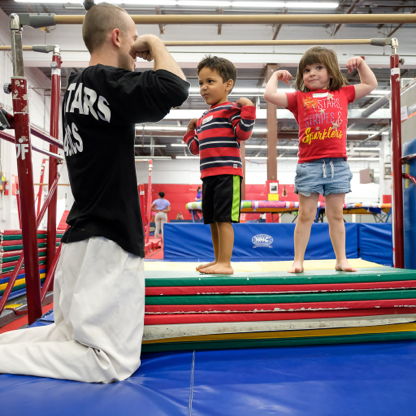

Your child cannot stop cartwheeling across the living room. They flip off the couch, roll across the yard, and turn every soft surface into a landing pad. Sound familiar?
If your child loves to tumble, a structured tumbling class channels that energy into real skills. But if you have never enrolled a child in one before, you probably have questions. What do they actually learn? Is it the same as gymnastics? What age should they start?
This guide covers what kids learn in a tumbling class, how to find the right program, and what beginner tumbling classes look like so you know exactly what to expect.
Tumbling is a branch of gymnastics focused on floor-based and trampoline skills. Think rolls, cartwheels, handstands, round-offs, back handsprings, and eventually flips and aerials.
Unlike traditional artistic gymnastics, tumbling classes do not typically involve apparatus work on bars or beam. The focus stays on the floor and the trampoline, which makes it a great fit for kids who love the acrobatic side of movement without needing to train across multiple pieces of equipment.
Tumbling classes build strength, flexibility, coordination, and body awareness. They also teach kids how to fall safely, control their momentum, and build the confidence to try new things.
The skills taught in a tumbling class follow a clear progression. Beginners start with foundational movements and work their way up as strength and technique develop.
These are the first skills most kids learn. Rolls teach body control, spatial awareness, and how to tuck and rotate safely. They build the foundation for every tumbling skill that follows.
Once rolls feel natural, kids move on to lateral movements. Cartwheels teach weight transfer through the hands, and round-offs add power and landing technique that set up more advanced skills later.
These positions build upper body strength and shoulder stability. Kids practice holding their weight on their hands, which is essential for back handsprings and beyond.
As students gain strength and confidence, they begin working on skills that move backward. Coaches use progressions and spotting to introduce these safely, building up to independent execution over time.
Many tumbling programs include trampoline training alongside floor work. The trampoline helps kids develop air awareness, timing, and rotation in a lower-impact setting before transferring those skills to the floor.
Most tumbling programs accept children as young as three years old. At this age, classes focus on basic body movements, balance, coordination, and getting comfortable in a gym environment.
By age five or six, kids are ready for more structured beginner tumbling classes that introduce proper technique on rolls, cartwheels, and handstands. Children who start at this age tend to pick up skills quickly because they have the strength and attention span to follow coaching cues.
Older kids and teens can absolutely start tumbling as beginners too. Programs designed for ages seven and up adjust the pace and intensity to match where each student is, so there is no such thing as being too late to begin.
Parents often wonder whether their child should take tumbling or gymnastics. The two are closely related, but the focus is different.
| Category | Tumbling | Artistic Gymnastics |
|---|---|---|
| Focus | Floor and trampoline skills | All apparatus: vault, bars, beam, floor |
| Skills | Rolls, cartwheels, handsprings, flips | Skills across multiple events plus tumbling |
| Equipment | Floor mats and trampolines | Bars, beam, vault, floor, and more |
| Best for | Kids who love flipping and bouncing | Kids who want a broader gymnastics experience |
| Progression | Leads to competitive tumbling and trampoline | Leads to competitive artistic gymnastics |
Many kids do both. Tumbling skills transfer directly to gymnastics, cheerleading, dance, martial arts, and diving. Starting with tumbling gives kids a strong physical foundation no matter where their interests lead.
Not all tumbling classes near me results are created equal. Here are a few things to check before enrolling your child.
Look for programs staffed by coaches with gymnastics or tumbling certification. Qualified coaches know how to spot safely, progress skills at the right pace, and create a positive learning environment.
A good program separates kids by age and ability level. A 3-year-old and a 10-year-old should not be learning in the same group, even if both are beginners. Proper grouping keeps classes safe and lets every child progress at the right speed.
Smaller groups mean more individual attention and safer learning. Look for programs that keep coach-to-student ratios low, especially for younger and beginner-level classes.
The best tumbling programs have a defined path from beginner through advanced. Ask how the program structures advancement and how coaches communicate progress to parents.
Check for padded floors, well-maintained equipment, and a clean training space. A program that takes safety seriously will be happy to show you around before you enroll.
At Silver Stars Gymnastics in Silver Spring, MD, the Tumbling and Trampoline (TNT) program teaches floor and trampoline skills to kids ages 3 through 17.
Kids who love tumbling can also explore Silver Stars' artistic gymnastics classes to train across all apparatus, or start with preschool gymnastics for the youngest beginners.
With over 32 years of experience, Silver Stars has helped thousands of kids in the Silver Spring and Washington, D.C. area build strength, confidence, and a love of movement.
Tumbling classes give kids a safe, coached space to build the skills they are already trying at home. Whether your child is three or thirteen, a beginner or ready for more, there is a program that fits.
Your first trial class at Silver Stars is free for new families and can be scheduled at any time. Join us today and watch your child turn those living room cartwheels into real skills.
What do kids learn in a tumbling class?
Kids learn floor and trampoline skills starting with rolls, cartwheels, and handstands. As they progress, they work toward round-offs, back handsprings, and more advanced flips and aerials.
What age should kids start tumbling classes?
Most programs accept children as young as three. Kids ages five and six are often ready for structured beginner classes. Older kids and teens can start as beginners too.
How is tumbling different from gymnastics?
Tumbling focuses on floor and trampoline skills. Artistic gymnastics covers multiple apparatus, including bars, beam, and vault in addition to floor work. Many kids benefit from both.
Are beginner tumbling classes safe for young kids?
Yes. A quality program uses padded equipment, trained coaches, and age-appropriate groupings to keep young beginners safe. Coaches use spotting and progressions to build skills gradually.
How do I find good tumbling classes near me?
Look for programs with certified coaches, small class ratios, age-appropriate grouping, and a clean, well-equipped facility. A free trial class is a great way to see whether the program is the right fit for your child.